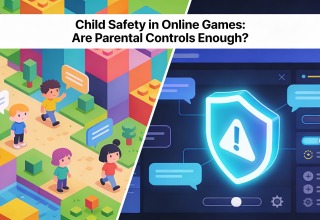
Games like Roblox and Minecraft that focus on creativity, building, and social play (also: LEGO Worlds, Fortnite, etc.), offer fun, kid-friendly adventures with building and exploration, often with parental controls for safer environments.
Games like these have over 70 million active daily users, letting kids create entire worlds out of nothing.
Roblox… Not the individual game you’d think, but a universe of user-made content, from obstacle courses (hobbies) to roleplay games and simulators, all available to consume on various devices. Players as well as developers alike love Roblox Studio, since creators can create their own games and get paid to do so.
As in real life, such a big world offers unsafe spaces, and parents need to monitor the friends and relationships in their kids’ worlds. There are questions out there in the real world about the safety of online games, and I think it’s something we need to talk about, cause let’s be honest, as a parent or guardian, do we have any idea how big this platform really is and how it all works?
Most of all, how safe is it to let your child have the freedom to delve into these worlds unsupervised?
Innocent Fun Laced With Danger?
How the platform works (for those of us who don’t know):
- Sign up for a New Account: Register and create your blocky avatar.
- Search: To find or search millions of free-to-play games or ‘experiences’.
- Play: Play a game immediately, whether it’s an obstacle course, tycoon game, or adventure simulator.
- Generate (Optional): With Roblox Studio, a game engine, make and launch your own games for other people to enjoy.
On one hand, you have creative innovation in play, and on the other, you have big lawsuits (most recently, one in the Louisiana Attorney General’s court alleging that Roblox is a hunting ground for predators).
How could an advanced engineering platform exist in tandem with such basic safety issues?
The Promise vs. The Pipedream
Roblox’s safety suite is impressive for the average parent.
The platform is pushing a multilayered defence architecture:
- Chat Filters: Automated ‘whitelist’ systems to block profanity and PII.
- Age Verification: Features enabling users to verify age by government ID to access ‘age-appropriate’ content.
- Parental Controls: PIN-locked settings for guardians to limit chat or curate experiences.
- Reporting Tools: All-encompassing’ Report Abuse’ button designed to prompt a review of bad behaviours.
So, where the problem really lies is that, although this all looks good on paper, recent investigative reports and legal filings suggest that these tools are, increasingly, ‘security theater’ rather than real safeguards.
The Chat Content
Predators are often known to use ‘coded language’, which is replacing letters with symbols or platform-specific slang, which allows them to bypass (get around) filters.
Worse yet, the tech has also been used mostly as a bridge to transfer the conversation to Discord or Telegram, where Roblox’s safety guidelines do not reach.
Let’s open discussions around child safety in online games. Automated systems are reactive, scan for ‘bad words’, but rarely monitor for what can be construed as grooming behavior.
Discussions around child safety in online games:
- A ‘Bot’ monitored safety shield may think a chatty conversation is just a regular chat and not recognize the ‘secret language’ used by predators.
- For most of their interactions, there are no mandatory checks to determine an individual’s age. When a safety feature has ‘age verification’ as a safeguard, that might simply mean they ask for a birthdate! This allows adults to pretend to be peers with no friction.
It’s only because of very many lawsuits that it has been brought to light that there were numerous adults who’ve managed to insert/infiltrate themselves into these ‘roleplay’ communities.
These adults/predators then pretended to be children for weeks or months without the platform’s systems ever picking up on the age difference.
Verification, behavioral patterns, and way of communicating – they all fooled security.
The Reporting Black Hole
In a number of documented cases, parents have reported explicit grooming attempts and received ‘no violation found’ responses (many of which were automated responses).
That implies a systemic reliance on A.I. and not enough human supervision.
This means the safety feature is now a liability, as the algorithm is not working as it should, and this lulls parents into a false sense of safety.
The Road Ahead
Better Technology. Experts in child safety and cybersecurity are starting to look at other, more sophisticated models as solutions:
- Behavioral A.I.: Not just ‘keyword scanning’, but ‘pattern recognition’. This tech looks for grooming behaviors, the kind where an older account suddenly inundates a new account with ‘Robux’ (in-game currency) and then requests to switch to another app.
- Zero-Knowledge Proofs (ZKP): This allows Roblox to verify a user’s age (via third-party apps) without Roblox ever storing any private ID information.
- Closed-Garden Servers: Creating ‘Verified Only’ zones where every user has been vetted through biometric or ID checks, creating a high-trust environment for younger children.
Conclusion
At the end of the day, the responsibility is always at the feet of the platforms, but the tech-savvy kids, the gamers, the developers, and the older siblings will need to stand up and demand better from them.
The first step toward safety is recognizing that these tools are not perfect and issues arise. Parental controls need to be monitored (annoyingly for the kids), but safety first!
You cannot just read a set of rules, then leave it all up to the platform to take care of the kids.