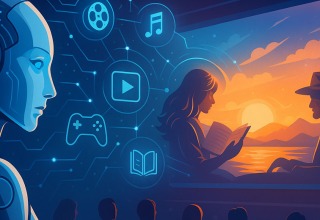
Artificial intelligence (AI) is no longer a concept confined to science fiction. It has firmly established itself in the entertainment industry, transforming how audiences consume, interact with, and even create content. From streaming platforms and gaming to music composition, film production, live performances, and even casinos, AI is revolutionizing the way we experience entertainment. Its impact is both subtle—like personalized recommendations—and striking, such as AI-generated actors or fully immersive virtual worlds.
This article explores the multifaceted ways AI is reshaping entertainment, the challenges it presents, and the exciting possibilities it opens for the future.
AI in Streaming and Personalized Content
Perhaps the most familiar example of AI in entertainment is streaming. Platforms like Netflix, Spotify, and YouTube rely on AI algorithms to analyze user behavior and preferences. Every click, pause, skip, and replay feeds into complex systems that predict what a viewer or listener is most likely to enjoy.
This personalization goes beyond simple recommendations. AI can create dynamic thumbnails, highlight scenes likely to capture attention, and even reorder playlists to match the user’s mood or listening habits. As a result, content consumption becomes more seamless, engaging, and tailored to individual preferences.
AI also enables content providers to manage massive libraries efficiently. By analyzing viewer trends and demographic data, platforms can decide which shows to promote, which new series to produce, and even when to release content for maximum impact. The result is a more intelligent, data-driven entertainment ecosystem.
Revolutionizing Gaming with AI
The gaming industry has been an early adopter of AI, with profound effects on gameplay, narrative, and user engagement. Modern games use AI to create adaptive opponents, intelligent NPCs (non-player characters), and dynamic worlds that respond to player choices. This makes each gaming experience unique, ensuring that no two playthroughs are the same.
Procedural generation, powered by AI, allows developers to create massive, open-world environments with intricate detail without manually designing every element. AI also plays a role in predictive analytics, helping developers understand player behavior, optimize difficulty levels, and maintain long-term engagement.
Competitive gaming, or eSports, benefits from AI as well. Advanced analytics track player performance, providing insights that enhance strategy and training. AI-driven matchmaking ensures fair competition by pairing players based on skill, playstyle, and past behavior, creating more balanced and engaging matches.
AI and Music: Composing the Future
AI is also transforming music creation. Programs like OpenAI’s MuseNet and AIVA can compose original music across genres, replicating the styles of famous composers or generating entirely new sounds. Musicians increasingly use AI as a collaborative tool, experimenting with melodies, harmonies, and rhythms that may not have occurred to a human composer.
Streaming platforms further integrate AI by curating personalized playlists. Services analyze listening patterns, skipping behaviors, and even time of day to recommend songs, creating a near-perfect soundtrack for every user. This data-driven approach not only enhances the listening experience but also helps artists understand audience preferences.
AI-generated music isn’t limited to background tracks. It is being used in commercials, video games, films, and virtual environments, offering customizable soundscapes that adapt in real time to user interactions or narrative developments.
Film and Television: AI Behind the Scenes
In film and television, AI is becoming an indispensable tool for both production and distribution. Studios use AI to analyze scripts, predict box office performance, and identify market trends. By examining historical data, AI can forecast what storylines, genres, or actors will resonate with audiences, helping studios make informed decisions about which projects to greenlight.
Visual effects (VFX) benefit immensely from AI. Tasks such as rotoscoping, motion capture, and CGI rendering can be accelerated by machine learning models, reducing production time and costs. AI also aids in post-production editing, color correction, and even dubbing or subtitling, improving efficiency without sacrificing quality.
In addition, AI is being used to create virtual actors, synthesize realistic voices, and bring historical figures or fictional characters to life in ways previously thought impossible. These tools expand creative possibilities, allowing filmmakers to tell stories on a scale and complexity that was unimaginable a decade ago.
Live Performances and AI-Enhanced Experiences
AI is increasingly influencing live entertainment as well. Performers can use AI to analyze audience reactions in real time, adjusting lighting, sound, and pacing to maximize engagement. AI-driven projection mapping and immersive stage effects can transform a traditional performance into an interactive spectacle, creating memorable, one-of-a-kind experiences.
Virtual concerts have also grown in popularity, with AI-generated avatars performing alongside human musicians. These events allow global audiences to experience performances without geographical limitations. AI can even simulate audience interaction, creating a sense of connection and spontaneity that mirrors live attendance.
Casinos and AI: Personalized Gaming and Smart Insights
Casinos are also embracing AI to improve customer experiences and operational efficiency. Algorithms analyze player behavior to offer personalized promotions, predict preferred games, and detect unusual betting patterns for responsible gaming measures. AI-driven analytics help casinos optimize layouts, slot machine placement, and game offerings to enhance revenue while keeping patrons engaged.
Some AI tools can even simulate player strategies to test new games before they’re released, ensuring that gameplay is both entertaining and fair. By integrating AI, casinos are not only improving the gaming experience but also gaining insights that inform smarter business decisions.
Virtual Reality, Augmented Reality, and AI
AI is a key enabler of immersive technologies such as virtual reality (VR) and augmented reality (AR). In VR, AI can dynamically adapt environments, characters, and storylines based on user actions, creating a deeply interactive experience. In AR, AI can recognize real-world objects and overlay information, graphics, or narratives in real time, blending the physical and digital worlds.
Gaming, education, tourism, and training simulations benefit from AI-powered VR and AR. For example, a VR game can learn a player’s tendencies, adjusting challenges to maintain engagement, while AR tours in museums or historical sites can offer personalized narratives and insights using AI-driven analysis of user interest.
Ethical Considerations and Challenges
Despite the exciting potential, AI in entertainment raises ethical questions. Issues of authorship and intellectual property are becoming increasingly complex as AI generates music, scripts, and visuals. Who owns an AI-generated composition—the programmer, the user, or the AI itself?
Data privacy is another concern. Many AI applications rely on detailed user data to provide personalization. Companies must handle this data responsibly, ensuring transparency and compliance with regulations.
Moreover, AI should enhance rather than replace human creativity. Maintaining the “human touch” in storytelling, performance, and artistic expression is critical to ensure that AI serves as a collaborator, not a substitute, for human ingenuity.
The Future of Entertainment with AI
Looking ahead, AI will continue to blur the lines between reality and imagination. Hyper-personalized content, adaptive gaming, AI-generated music, and virtual performances will become more sophisticated and seamless. Audiences may even co-create experiences with AI, influencing narratives, soundscapes, and visual elements in real time.
Entertainment may become more accessible, inclusive, and interactive, with AI enabling creators to reach global audiences without compromising artistic quality. As the technology evolves, collaboration between humans and machines will likely define the next era of creativity.
Conclusion
AI is no longer a supporting tool in entertainment—it is a creative partner, data analyst, and immersive designer. Its influence spans streaming, gaming, music, film, live performances, VR/AR, and even casinos, where personalized experiences are enhancing engagement. While challenges such as ethics and data privacy remain, the potential for AI to enrich entertainment is immense.
The rise of AI signals a future where entertainment is not just consumed but experienced, adapted, and co-created. As intelligent algorithms work alongside human creators, audiences can look forward to richer, more immersive, and highly personalized forms of fun and storytelling. The collaboration between humans and AI promises a new frontier in entertainment—one that is only just beginning to unfold.